Belleterre
Location
Belleterre – Abitibi-Témiscamingue (Qc)
Area
68,729 ha
Commodities
Au (Orogenic), Cu-Zn-Ni (VMS, sedimentary and magmatic)
Status
100% Vior Gold Corporation
Option J.A.G. (100%)
Option Windfall Mining Group (75%)
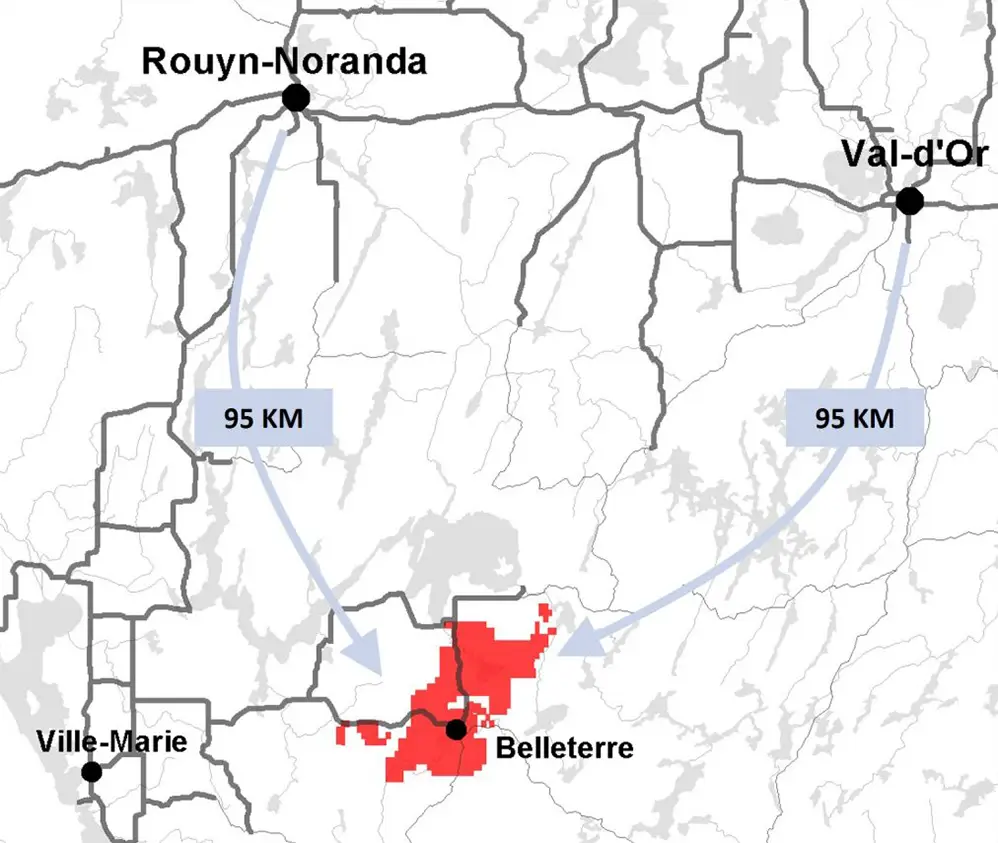
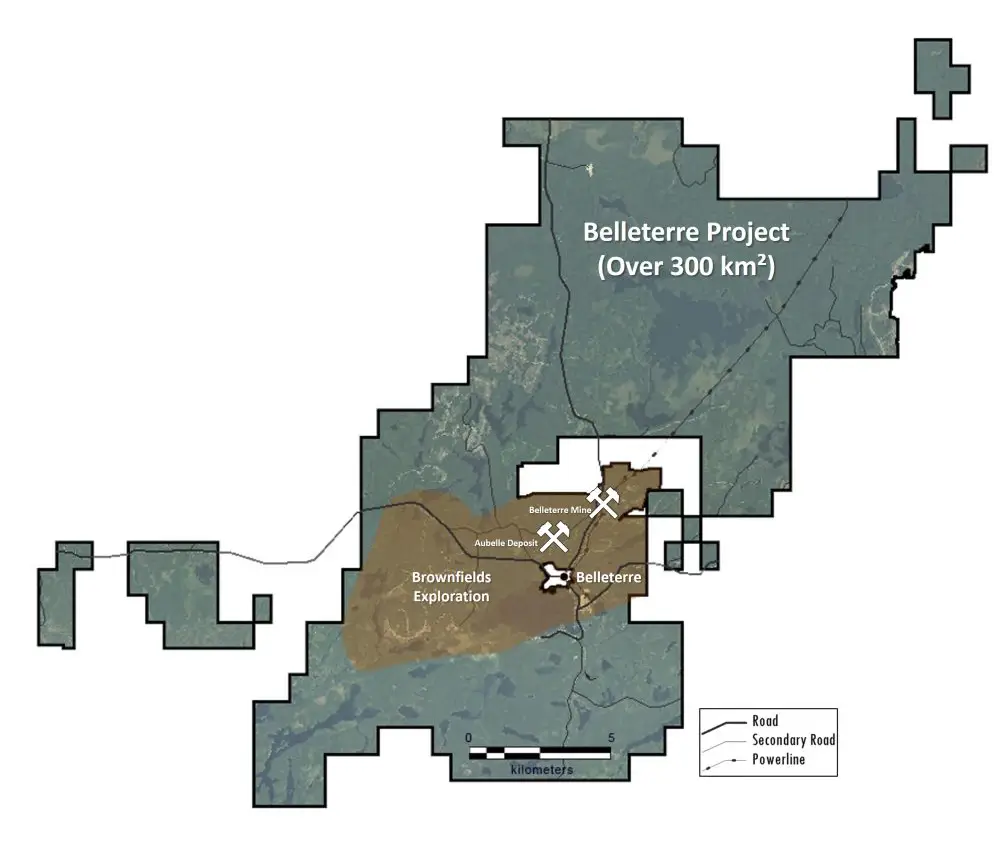
The project is located in Belleterre, Québec, approximately 95 kilometers south of Rouyn-Noranda, within the prolific Abitibi-Témiscamingue region. It extends over a length of 37 km and includes the former high-grade Belleterre gold mine, which closed in 1957 after producing 2.18 million metric tonnes at an average grade of 10.73 g/t Au and 1.37 g/t Ag (750,000 oz Au and 95,000 oz Ag; source: DV-85-08, MRNF website, Examine database).
The region has been underexplored over the past 60 years and has never undergone such significant consolidation until now. Since 2020, the Belleterre area has been consolidated and expanded by Vior Gold Corporation through agreements and acquisitions from individuals and companies, as well as through map designation of exclusive exploration rights (EER).

Geology and Mineralization
The Belleterre project is located in the eastern part of the Belleterre-Angliers volcanic belt, with the Baby and Lac des Bois groups forming the western and central portions, respectively. It is part of the Pontiac Subprovince, located south of the Abitibi Subprovince. Metasedimentary rocks of the Pontiac Group border it to the east, while it is otherwise surrounded by a series of granitoids belonging to the TTG (tonalite–trondhjemite–granodiorite) and MMGS (monzonite–monzodiorite–granodiorite–syenite) suites.The volcanic rocks are interpreted to be mostly younger (2690–2682 Ma; Mortensen and Card, 1993) or contemporaneous (2724–2715 Ma for the Belleterre and Baby segments; Koita, 2019) with those of the Abitibi.
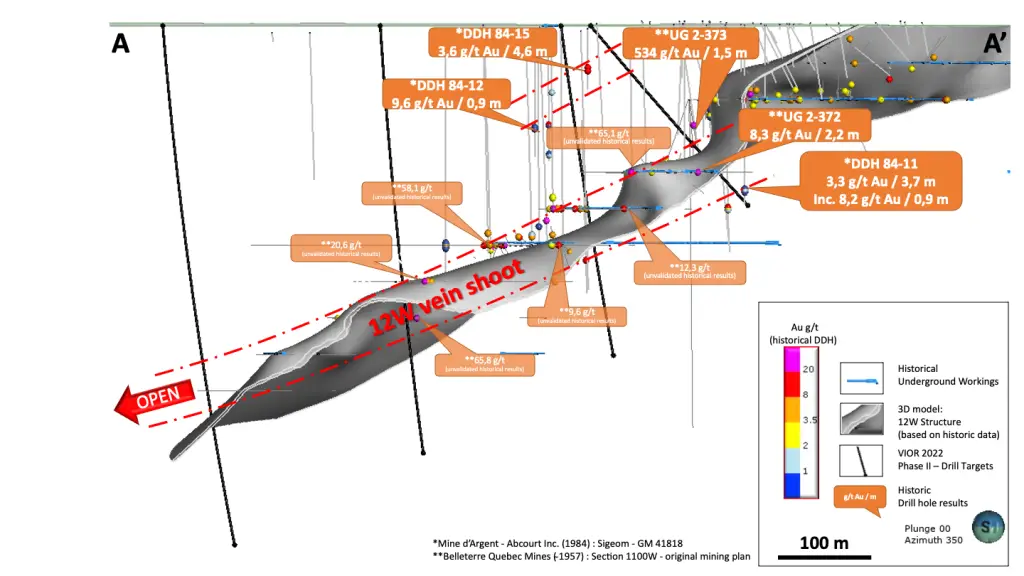
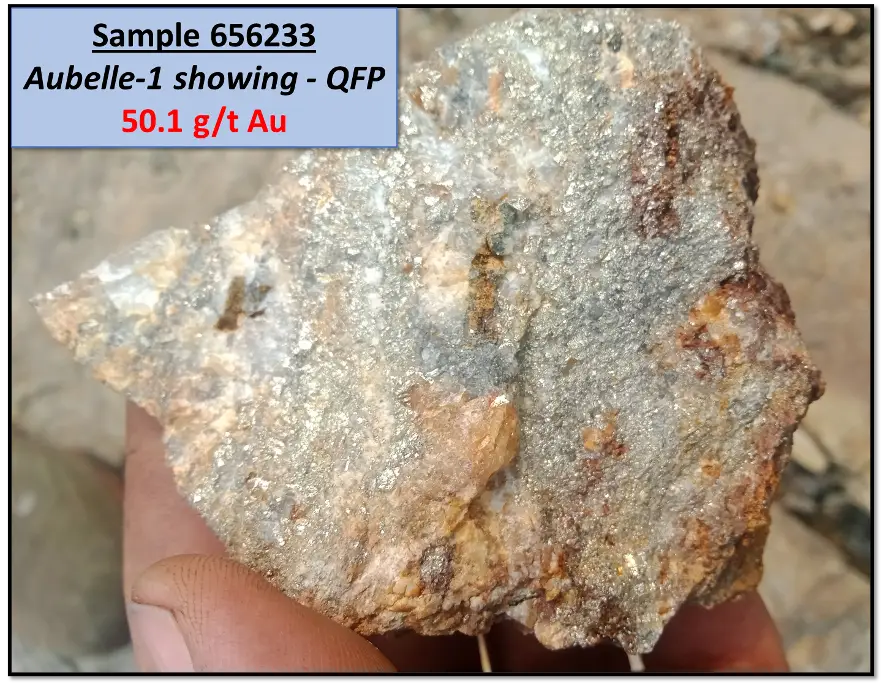
The Belleterre project hosts numerous gold showings representing various types of mineralization. The most common occurrences are extensional and shear-hosted quartz vein systems (orogenic type), including the deposit mined at the former Belleterre mine. The 12 and 12 West veins (the most significant and the source of gold production) cut through a sequence of brecciated basalt affected at the contact by vein emplacement. Due to rheological contrast, other mineralized veins are injected along basalt–chert interfaces. The quartz, typically milky or smoky in appearance, is associated with pyrite, with local occurrences of pyrrhotite, chalcopyrite, sphalerite, and galena. Gold may occur as free and visible gold in certain veins.
The Belleterre region is also known for its potential in critical and strategic minerals such as zinc, copper, and nickel. Regional exploration programs carried out in 2023 and 2024 identified a favorable and distinct volcano-sedimentary rock unit within the Pontiac sedimentary rocks that hosts strong anomalous base metal values.
Prospected electromagnetic (“EM”) conductors returned channel sample values of 0.51% Cu, 0.3% Ni, 1.06% Zn, and 0.06% Co over 3 meters, while the best grab samples returned: (1) 0.6% Cu, 2.73% Zn, and 7.7 g/t Ag; (2) 0.34% Ni and 0.17% Zn; and (3) 1.91% Zn and 0.11% Cu.
Exploration History
Gold exploration in the Belleterre region began in the 1930s following the discovery of an initial gold showing (Loken) near Lac Soufflot. This marked the start of a staking rush that led to the discovery of additional gold showings and the commissioning (1936) of the Belleterre gold mine by McIntyre Porcupine Mines Ltd.
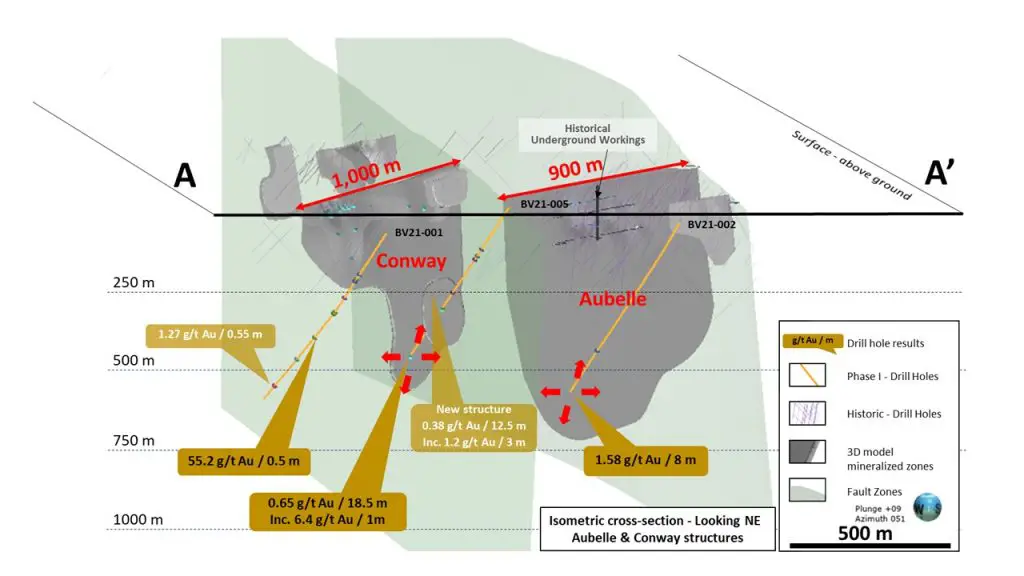
Early exploration work focused on intensive trenching, stripping, and short drilling campaigns. The Belleterre mine closed in 1957. Subsequently, several companies carried out exploration work, including geophysical surveys, drilling campaigns, and prospecting in the Aubelle deposit area and around the former Belleterre mine.
Recent Work Completed by Vior Gold Corporation
Since 2020, the Belleterre area has been consolidated and expanded by the Company through various acquisition agreements with individuals and corporations, as well as through the acquisition of exclusive exploration rights.
Vior Gold Corporation has conducted significant regional-scale exploration programs, including compilation of historical data, airborne magnetic and EM geophysical surveys, re-evaluation of known showings, mechanized stripping, as well as prospecting, till sampling, and mapping across the entire project.
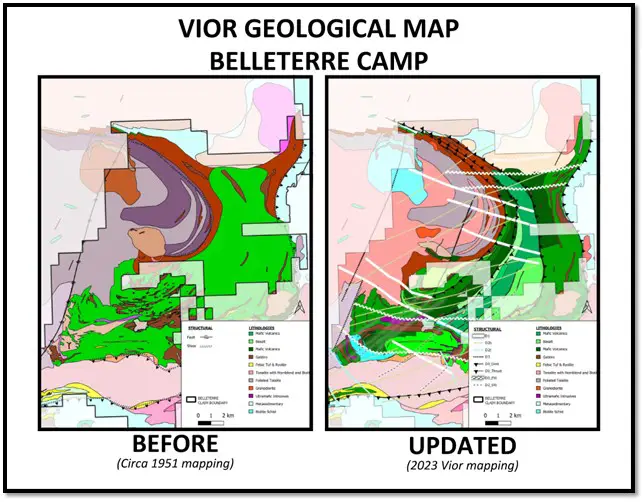
This work has resulted in an updated geological map of the belt and the modeling of the former Belleterre mine.
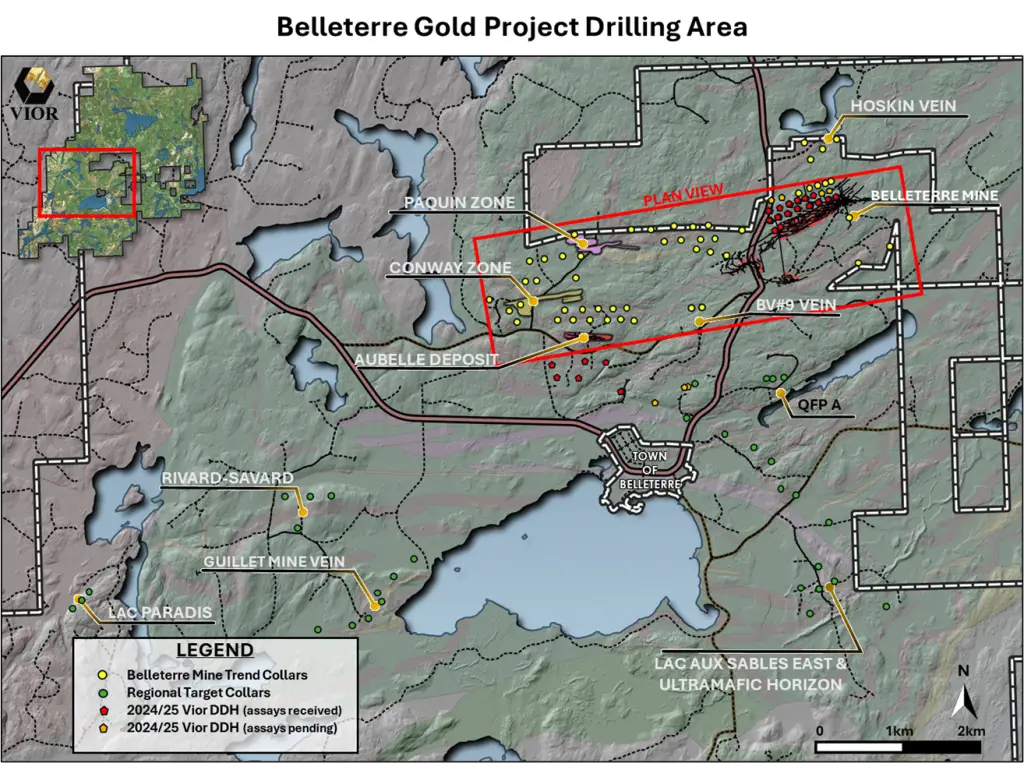
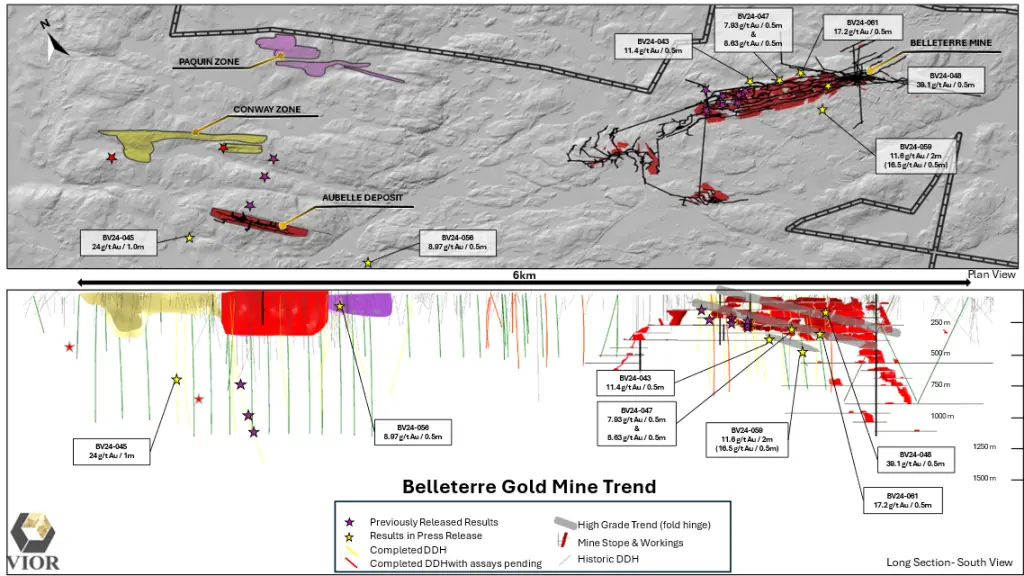
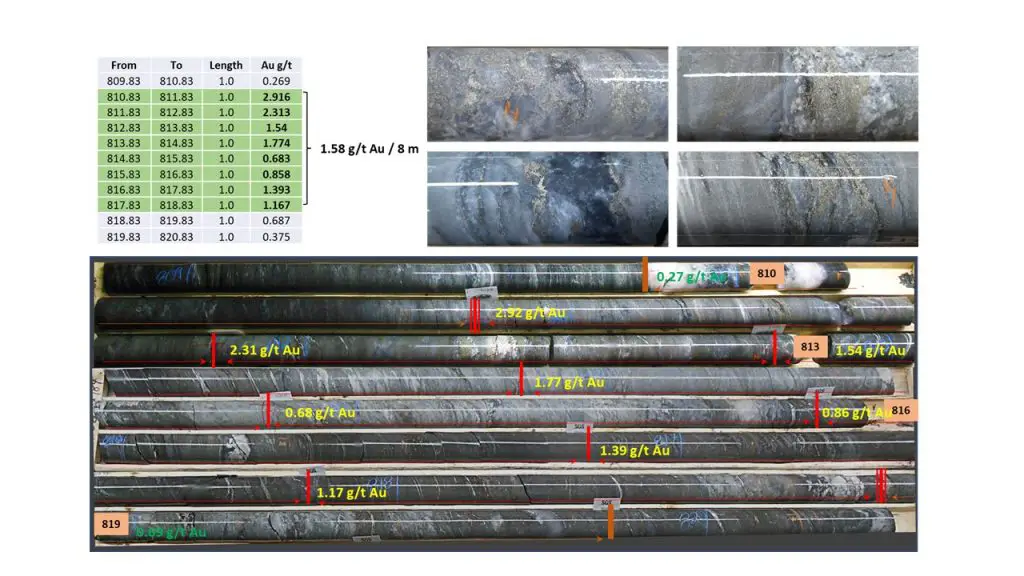
In October 2024, Vior Gold Corporation announced the start of a drilling program totaling more than 60,000 metres on the Belleterre project. The majority of the drilling is designed to systematically test the lateral and vertical extensions of the former Belleterre mine and the Aubelle deposit.
During 2025, Vior Gold Corporation expanded its drilling program to 100,000 metres to focus on regional exploration targets such as the Lac Guillet deformation zone, located 2 kilometres south of the former Belleterre mine corridor.
Since 2021, Vior Gold Corporation has completed a total of 130,531 metres of drilling on the Belleterre project, including 105,922 metres completed in 2025. The Company expects to complete the ongoing drilling program in the first quarter of 2026.